HINTER DEN KULISSEN — Ausstellungsarchitektur für Bollinger+Grohmann im Deutschen Architekturmuseum · Frankfurt 2013, Bild 1
- [01]
- [02]
- [03]
- [04]
- [05]
- [06]
- [07]
- [08]
- [09]
- [10]
- [11]
- [12]
HINTER DEN KULISSEN
Zeitraum: Konzept 2012, realisiert 06/2013 — Ausstellungszeitraum: 14. Juni – 01. September 2013
Leistung: Konzept, Kuratorin, Ausstellungsarchitektur, Bauleitung
ORT
Für die Ausstellung stand ein Raum im ersten Obergeschoss des Deutschen Architekturmuseums (DAM) zur Verfügung. Das Gebäudekonzept des Museums wurde in den 1980er-Jahren von Oswald Mathias Ungers entwickelt, der die Gründerzeitvilla entkernte und ein „weißes Haus” in das Gebäude stellte. Gekrönt wurde dieses Konzept von einer Struktur im Inneren des Museums, dem „Haus-im-Haus”. Die erste Aufgabe in Bezug auf den Ausstellungsraum war somit die Auseinandersetzung mit dem Ungerschen Konzept und den entsprechenden Rahmenbedingungen des Raumes.
PLASTISCHES BAND
Die international agierenden Tragwerksplaner Bollinger+Grohmann Ingenieure wurden vom DAM eingeladen, ihr Büro und ihre Arbeit im Rahmen einer Ausstellung zu präsentieren. Kern der Ingenieursarbeit ist der iterative Prozess mit Architekten, Designern und Künstlern von der ersten Idee bis zum fertigen Projekt. Daher bildete diese prozesshafte Arbeit die Leitlinie der Ausstellung.
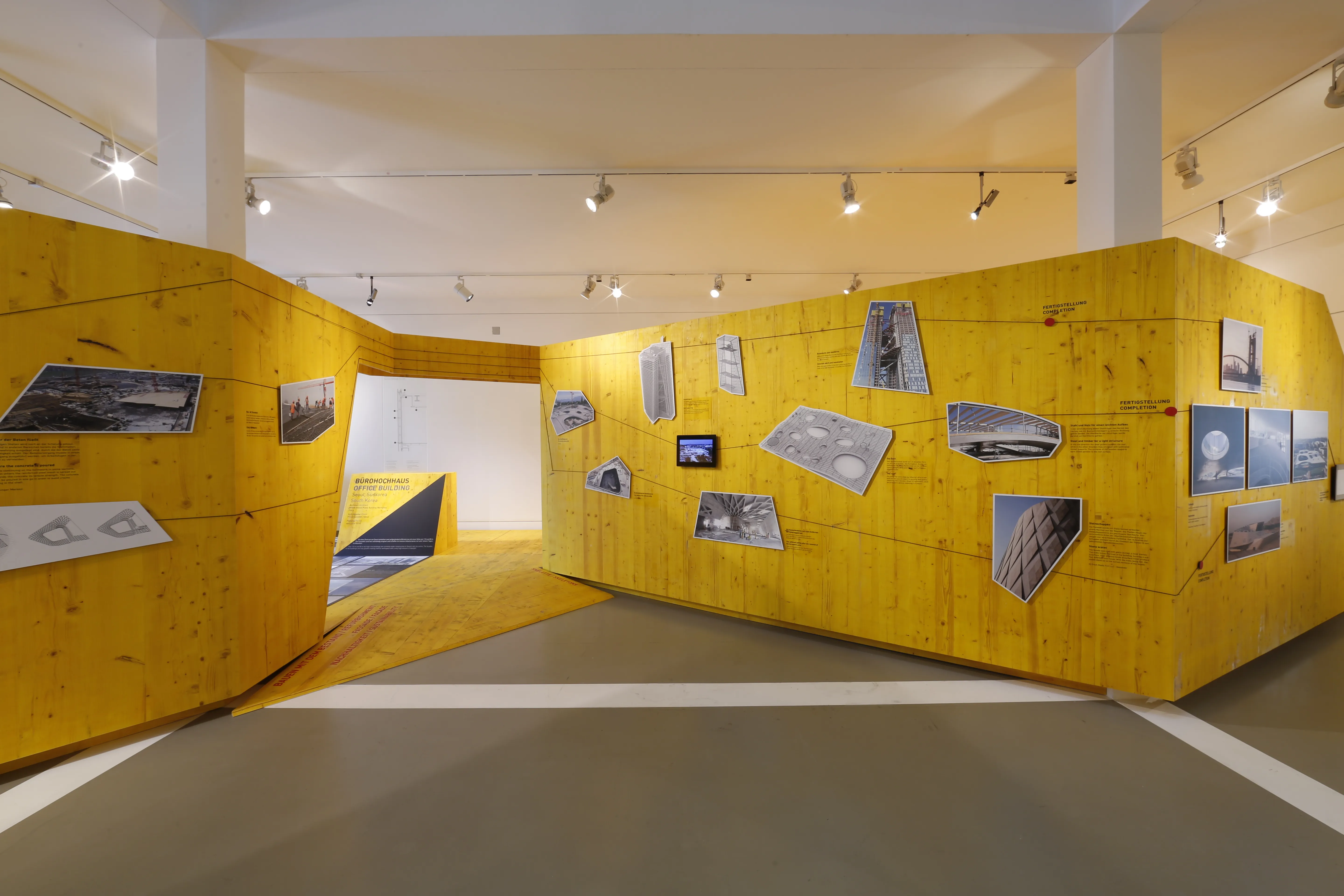
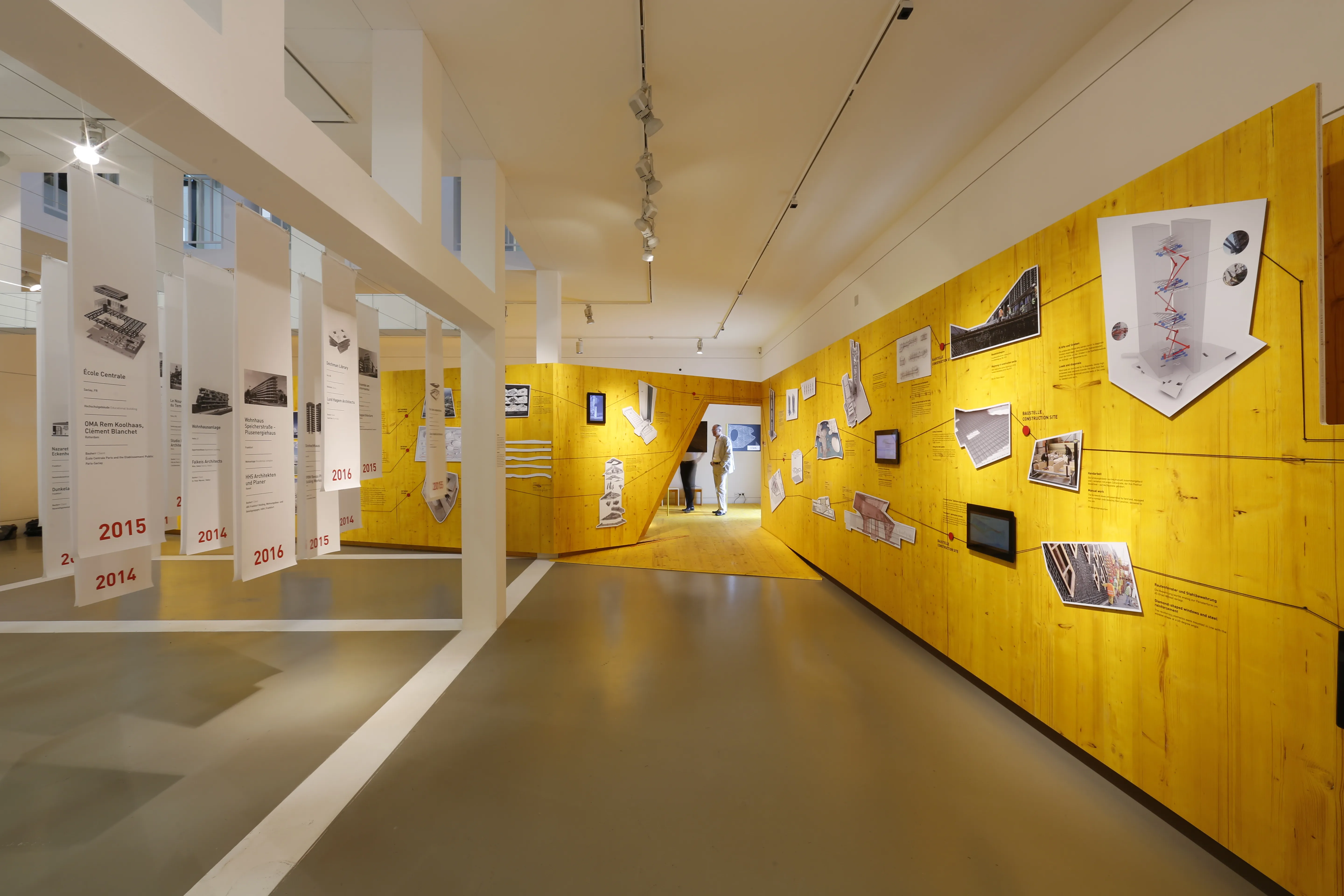
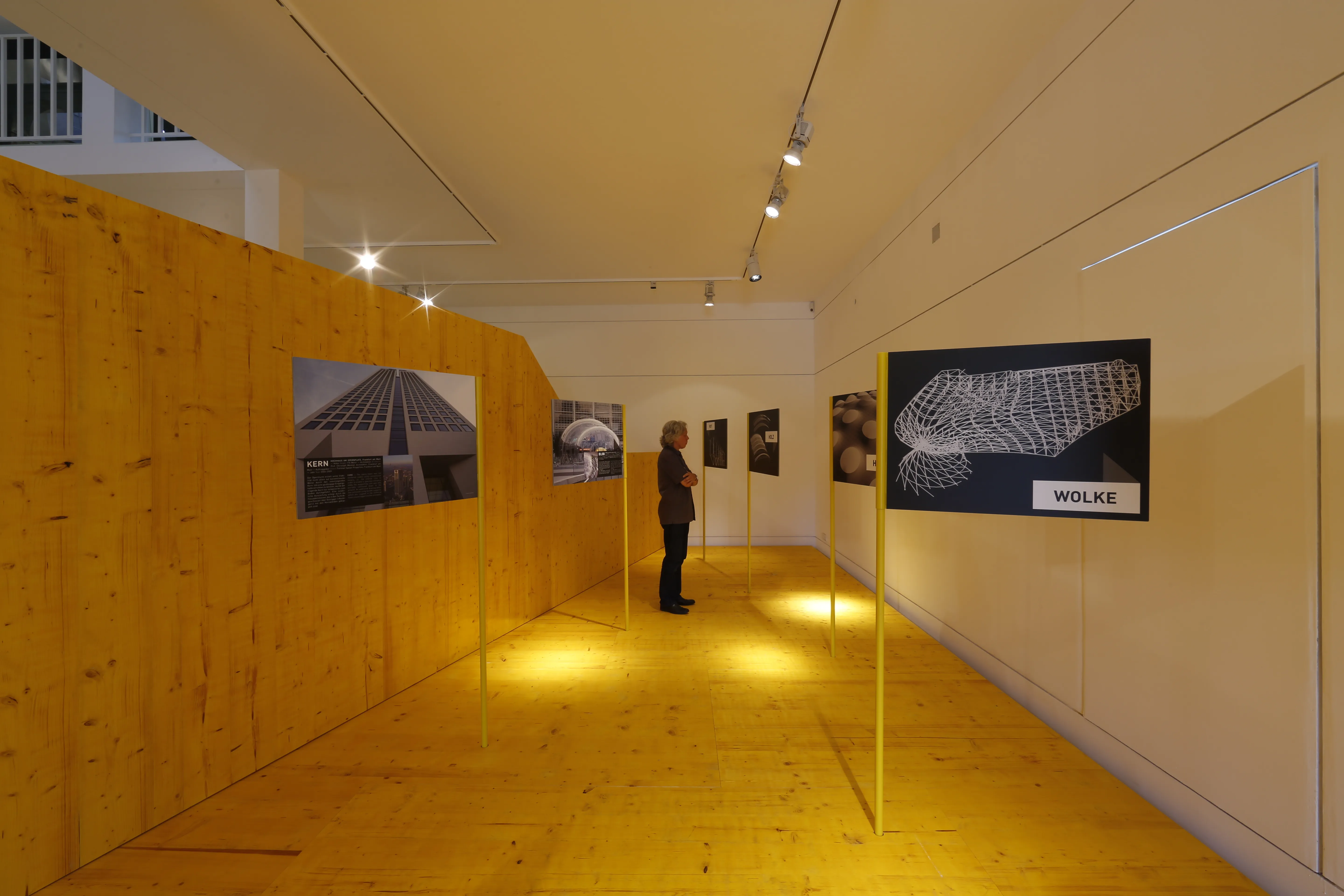
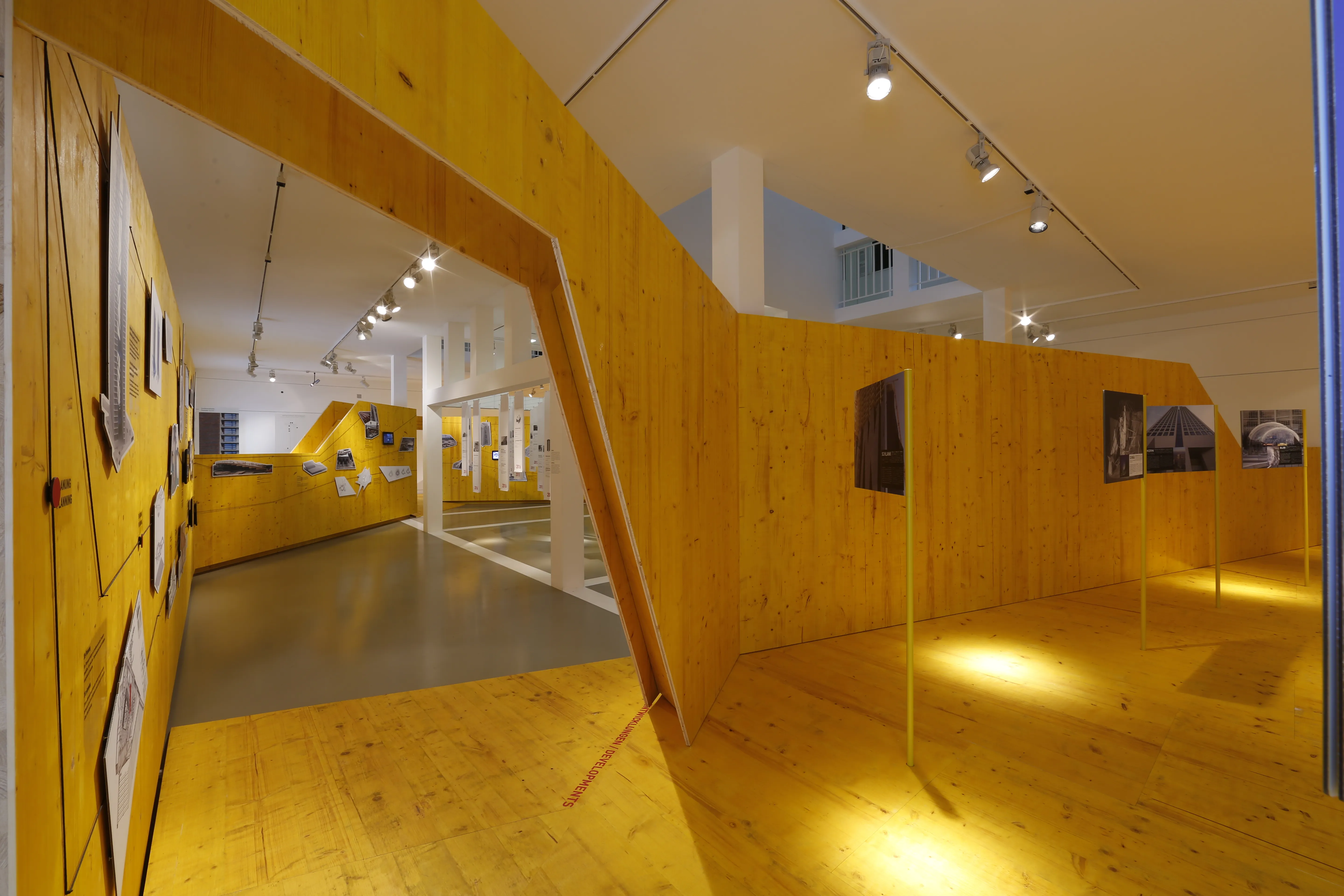
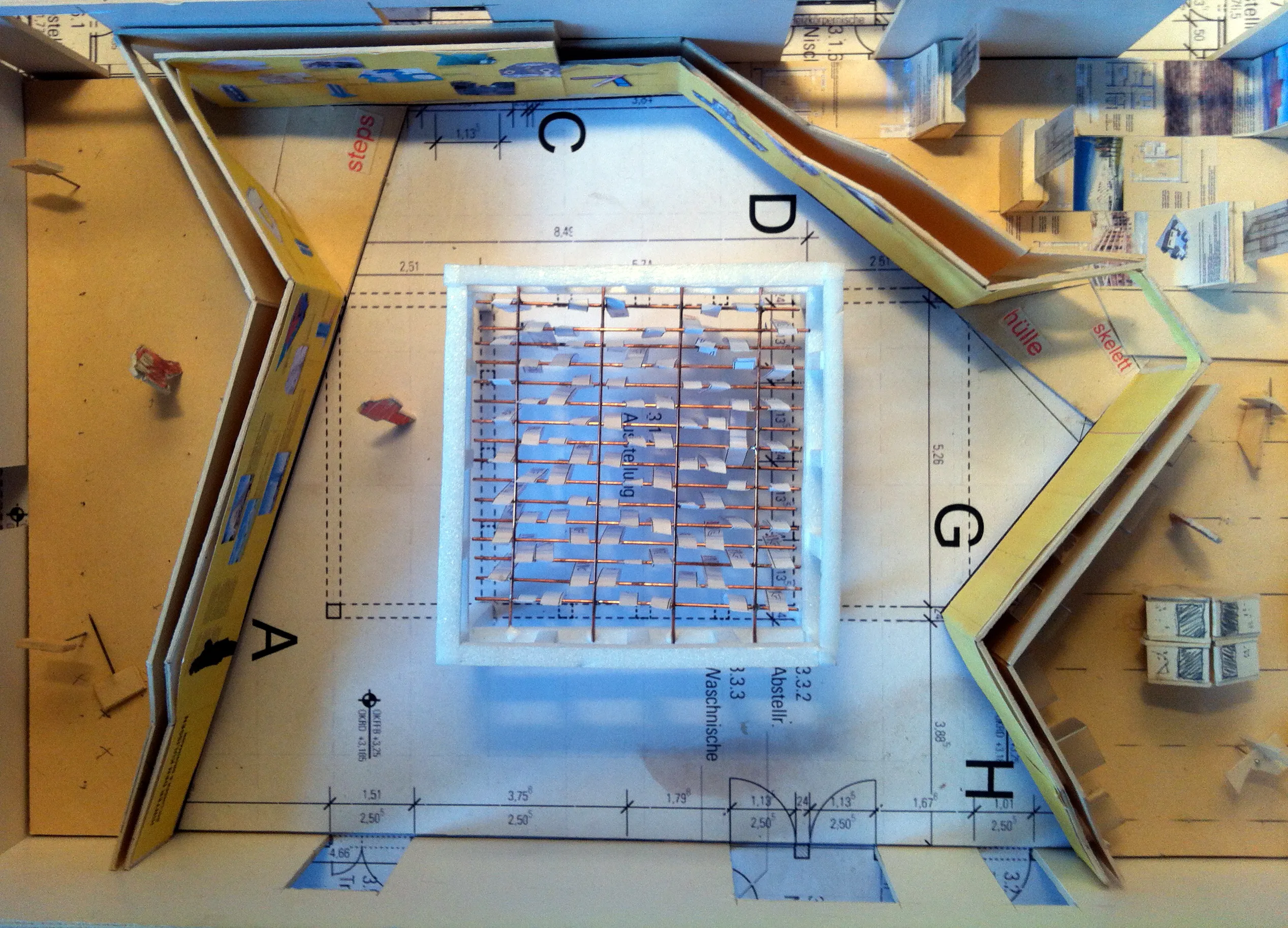
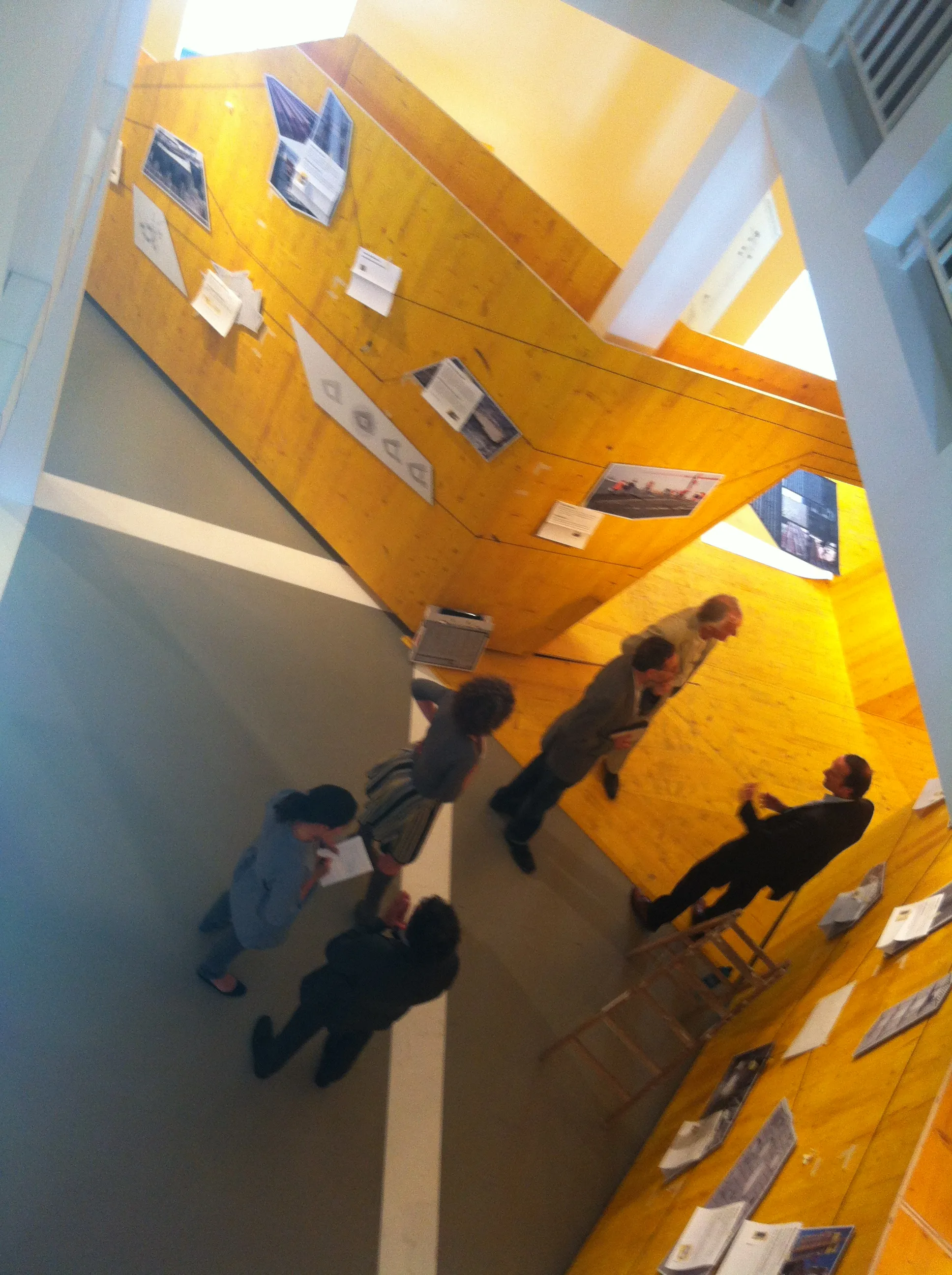
Der Titel „Hinter den Kulissen” sollte diesen Prozess verdeutlichen und gleichzeitig den Blick „über die Schulter” oder „hinter den Bauzaun” thematisieren. Ausstellungsarchitektonisch wurde dies durch die räumliche Installation eines plastischen Bandes aus gelben Schaltafeln umgesetzt, das sich sowohl vom Boden als auch von den Wänden des Museums abhob. Das von O.M. Ungers konzipierte „Haus im Haus” wurde dabei als Projekt-Installation reaktiviert. So konnten Besucher den Prozess auf dem Band als Geschichte des jeweiligen Projektes – räumlich und zeitlich dargestellt – ablesen.
Gleichzeitig entstanden durch die Formation des Bandes unterschiedliche Räume, die als „Kabinette” vertiefenden Sonderthemen gewidmet waren. Der Einsatz verschiedener Medien – von Modellen über Pläne bis hin zu interaktiven Computersimulationen – machte die Arbeit „hinter den Kulissen” greifbar. Die Besucher konnten durch Interaktion erkennen, was aus tragwerksplanerischer Sicht in den Gebäuden steckt, die sie teilweise tagtäglich sehen.
ENTWURF – PROZESS – AUSFÜHRUNG: MEDIENWECHSEL
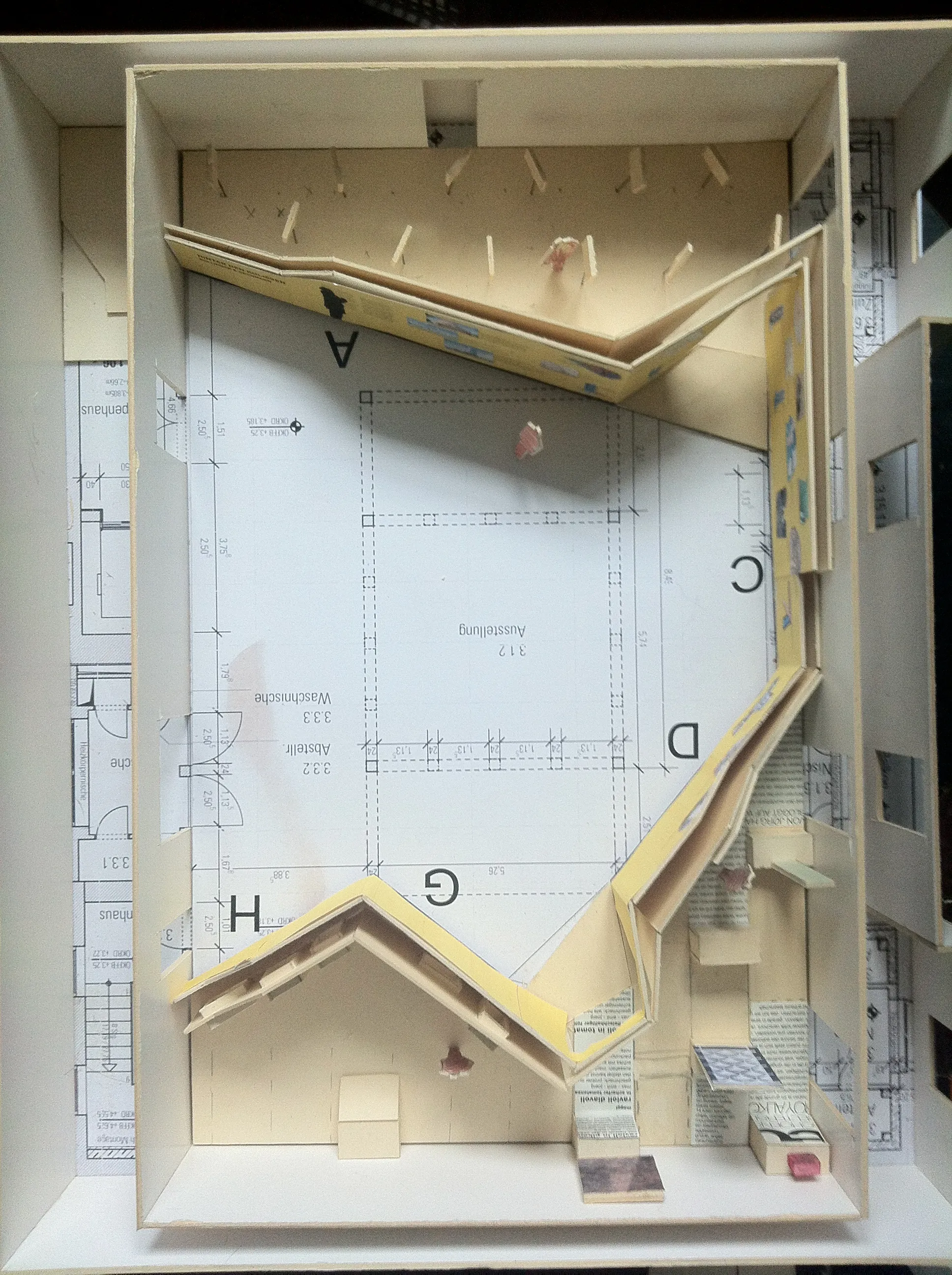
Von der Konzeptfindung über die Produktion und Vorfertigung bis hin zum Aufbau der Ausstellung wurde mit unterschiedlichen Techniken und Programmen gearbeitet. Erste Ideen wurden traditionell mittels Handskizzen, Papp- und Styrodurmodellen formuliert, anschließend über verschiedene Visualisierungsprogramme verfeinert, mithilfe von 3D-Modellierungssoftware (Rhino, Grasshopper) konstruiert und schließlich in transportablen Elementen vorgefertigt. Diese konnten im Museum in kürzester Zeit auf- und abgebaut werden.
PROZESS
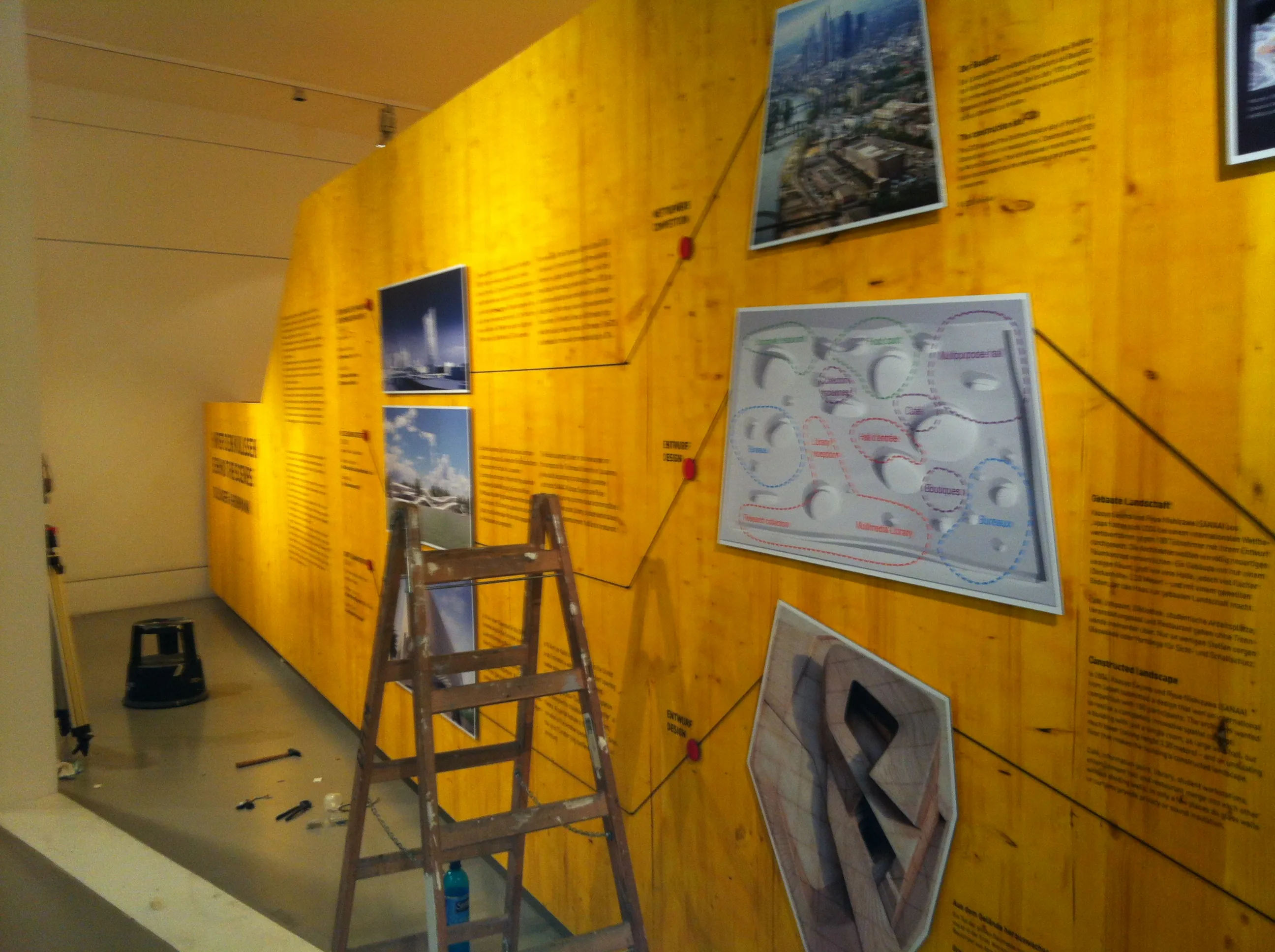
Raumbildend wickelt sich das Prozessband aus gelben Schaltafeln durch den Raum. Auf dessen raumweisender Seite befinden sich die Exponate, die den Arbeitsprozess am Beispiel dreier Projekte verdeutlichen. Wie Schnappschüsse auf einem Zeitstrahl sind Pläne, Fotos, Filme und Zeichnungen mit Abstand auf der Wand angebracht. Ein „roter Faden” verknüpft die Exponate zum Verlauf eines Prozesses.
ENTWICKLUNGEN
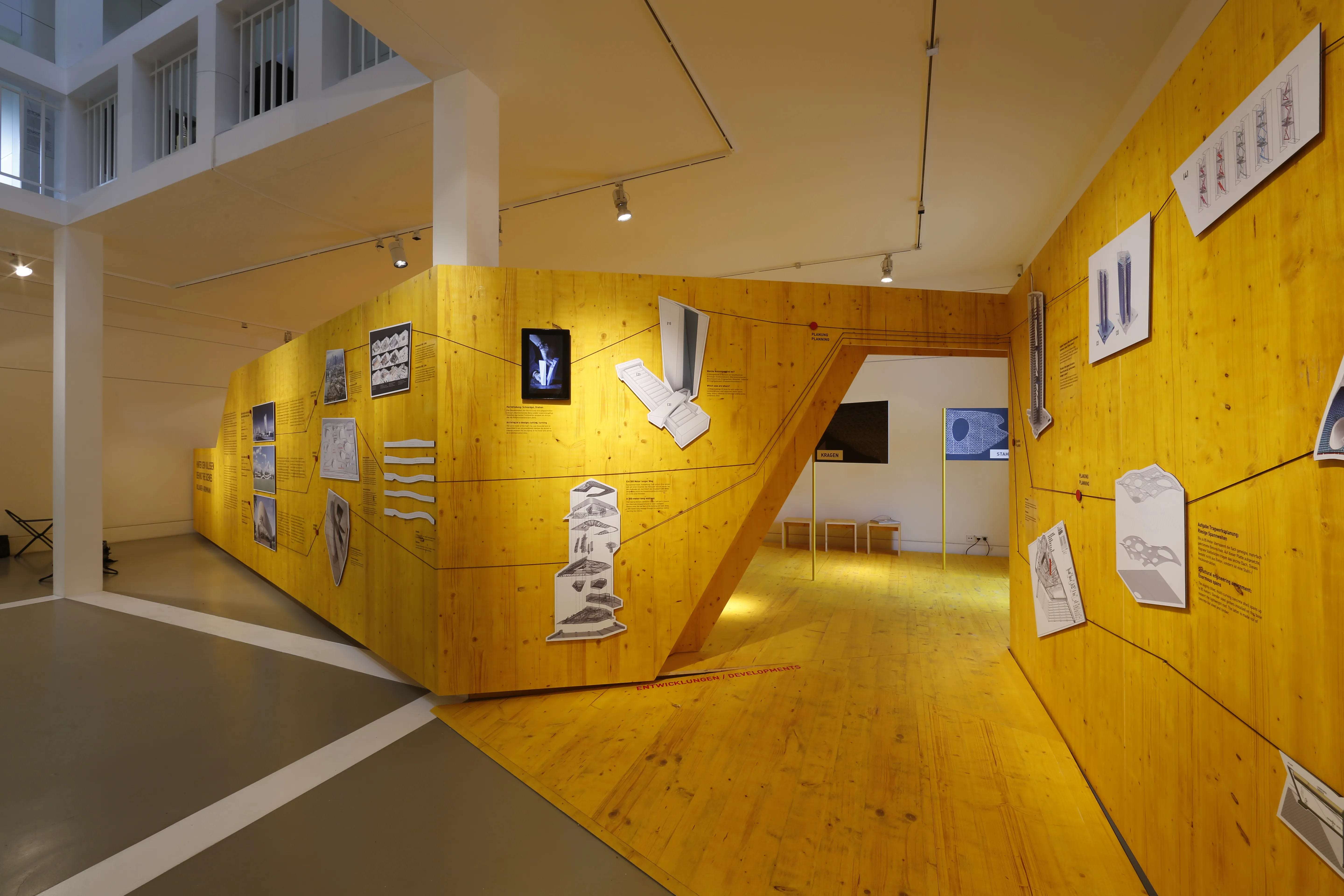
Technische Entwicklungen hatten für das Büro stets großen Einfluss auf die tragwerksplanerische Tätigkeit. In diesem Kabinett wurden die wichtigsten Schritte anhand wegweisender Projekte mit dem jeweiligen technischen Schwerpunkt dargestellt. Die Ausstellungsarchitektur nutzt hier eine Markierung in Form von drehbaren Fahnen, die die einzelnen technischen Meilensteine kennzeichnen.
HÜLLE
Nicht zuletzt aufgrund ökologischer Anforderungen zählt die Entwicklung komplexer Gebäudehüllen und Fassaden immer stärker zum Aufgabenbereich der Ingenieure. Das Spektrum reicht von gedämmten Ziegelsteinen bis hin zu fragilen Membrankonstruktionen als Sonnenschutz. Die Ausstellungsarchitektur präsentiert hier Detailzeichnungen der Fassaden als Exponate auf Sockeln. Die Projektinformationen erstrecken sich in Bändern über den Boden des Kabinetts bis hin zum jeweiligen Objekt.
SKELETT
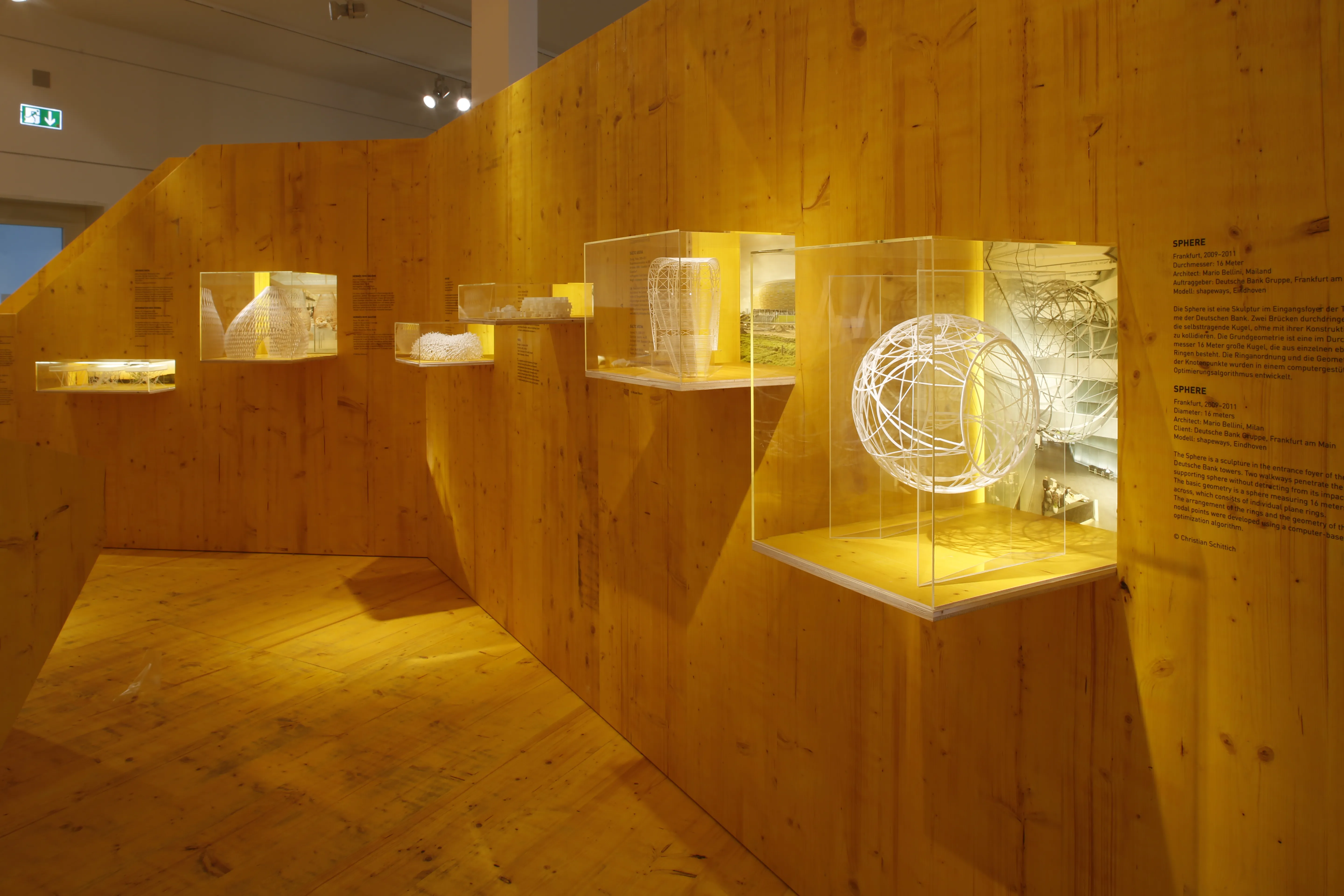
Hier wurden Projekte vorgestellt, deren Tragwerk besondere Herausforderungen an die Ingenieure stellte. Einige Skelettstrukturen wurden parametrisch entworfen. Die Besucher konnten die Tragstrukturen anhand kleiner Modelle nachvollziehen, die in zwei Fällen auch als 1:1-Knoten für einen direkten Vergleich ausgestellt waren. Zusätzlich boten interaktive Stationen die Möglichkeit, selbst auszuprobieren, wie die Veränderung von Rahmenbedingungen – der „Parameter” – die Struktur eines Tragwerks beeinflusst.
CHRONIK
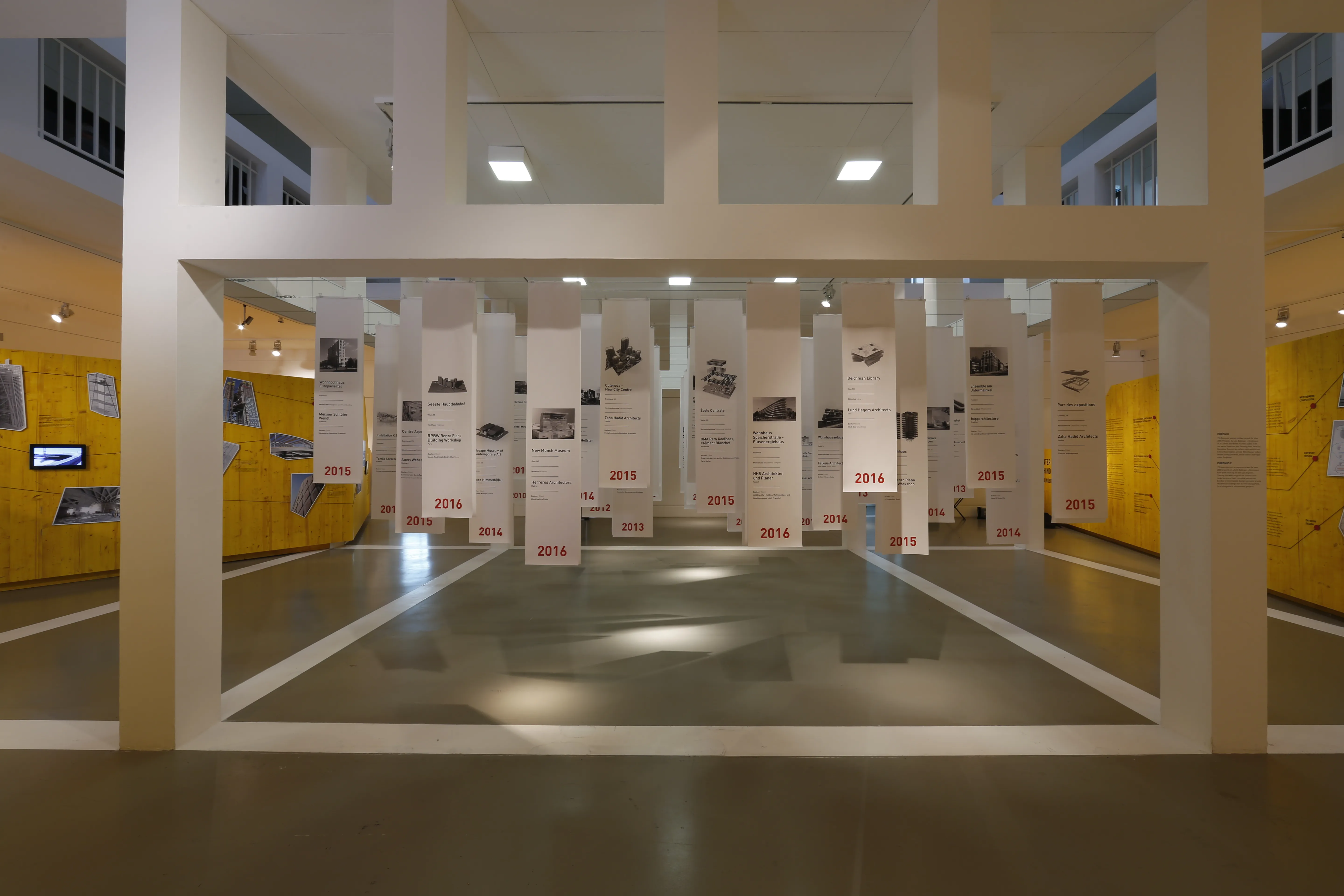
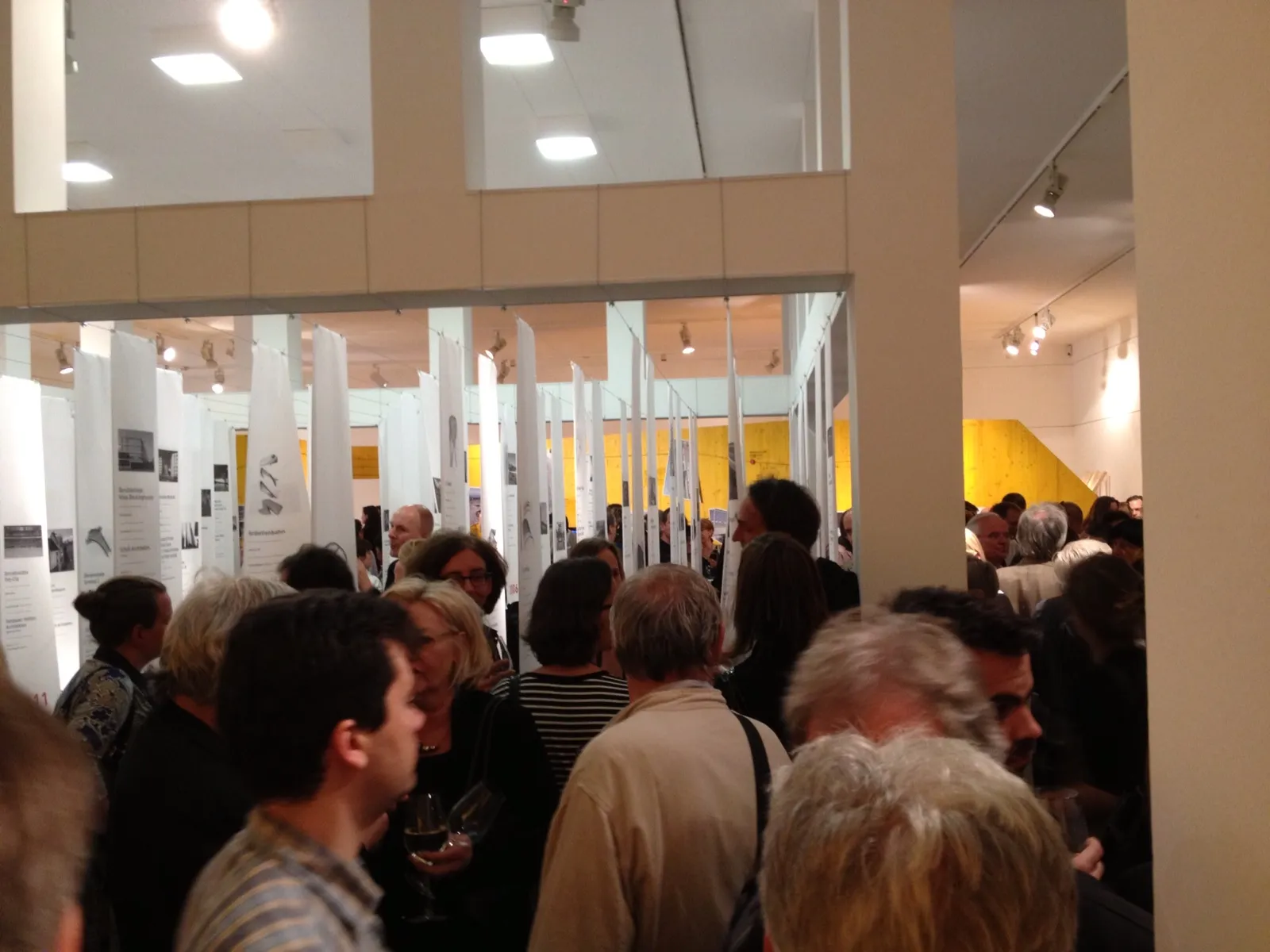
Im Zentrum der Ausstellung, vom Prozessband umschlossen, befindet sich der Bereich „CHRONIK”. In Form von hängenden Fahnen, durch die der Besucher streifen kann, wird die Arbeit der Tragwerksplaner von der Bürogründung bis zum Ausstellungsbeginn dargestellt. Konstruktiv wird diese Installation durch das „Haus-im-Haus” unterstützt, das im Zentrum des Geschosses steht. Es wurde sozusagen reaktiviert und wandelte sich von einer passiven Raumstruktur zur aktiven Tragkonstruktion für die Fahnen.
Period: Concept 2012, realised 06/2013 — Exhibition period: 14 June – 1 September 2013
Services: Concept, curatorship, exhibition architecture, site supervision
LOCATION
A room on the first floor of the German Architecture Museum (DAM) was available for the exhibition. The museum’s architectural concept was developed in the 1980s by Oswald Mathias Ungers, who stripped the Gründerzeit villa back to its shell and placed a “white house” inside the building. This concept was crowned by a structure within the museum’s interior — the “house within a house”. The first task in relation to the exhibition space was therefore to engage with Ungers’ concept and the spatial conditions it imposed.
PLASTIC BAND
The internationally active structural engineers Bollinger+Grohmann were invited by the DAM to present their practice and their work in an exhibition. At the core of their engineering work is an iterative process with architects, designers and artists from the initial idea to the finished project. This processual way of working therefore became the guiding thread of the exhibition.
The title “Behind the Scenes” was meant to illuminate this process while also evoking the idea of looking “over the shoulder” or “behind the hoarding”. In terms of exhibition architecture, this was realised through a spatial installation of a plastic band made of yellow formwork panels that lifted off both the floor and the walls of the museum. The “house within a house” conceived by O.M. Ungers was reactivated as a project installation. Visitors could read the process on the band as the story of each respective project — presented both spatially and chronologically.
At the same time, the formation of the band created different spaces dedicated as “cabinets” to in-depth special topics. The use of various media — from models and drawings to interactive computer simulations — made the work “behind the scenes” tangible. Through interaction, visitors could discover what, from a structural engineering perspective, lies within the buildings they often pass every day.
DESIGN – PROCESS – EXECUTION: CHANGE OF MEDIA
From concept development through production and prefabrication to the construction of the exhibition, different techniques and programmes were employed. Initial ideas were formulated using traditional methods — hand sketches, cardboard and styrofoam models — then refined through various visualisation programmes, constructed using 3D modelling software (Rhino, Grasshopper), and finally prefabricated in transportable elements. These could be assembled and dismantled in the museum in the shortest possible time.
PROCESS
The process band of yellow formwork panels winds through the space, defining rooms. On its outward-facing side are the exhibits illustrating the working process through three example projects. Like snapshots on a timeline, plans, photographs, films and drawings are mounted at intervals on the wall. A “red thread” links the exhibits into the course of a process.
DEVELOPMENTS
Technological developments have always had a major influence on structural engineering practice. In this cabinet, the most important steps were presented through key projects, each with a particular technical focus. The exhibition architecture uses a marker in the form of rotating flags that identify each technological milestone.
ENVELOPE
Not least due to ecological requirements, the development of complex building envelopes and facades has become an increasingly important area of engineering work. The spectrum ranges from insulated brickwork to fragile membrane structures as solar shading. Here the exhibition architecture presents detailed facade drawings as exhibits on plinths. Project information extends in strips across the floor of the cabinet to the respective object.
SKELETON
This section presented projects whose load-bearing structures posed particular challenges for the engineers. Some skeletal structures were designed parametrically. Visitors could understand the load-bearing structures through small models, two of which were also exhibited as 1:1 nodes for direct comparison. Interactive stations additionally offered the opportunity to try out for oneself how changing parameters influences the structure of a load-bearing system.
CHRONICLE
At the centre of the exhibition, enclosed by the process band, is the “CHRONICLE” area. In the form of hanging flags through which visitors can wander, the work of the structural engineers is presented from the founding of the practice to the opening of the exhibition. Structurally, this installation is supported by the “house within a house” that stands at the centre of the floor. It was, so to speak, reactivated — transforming from a passive spatial structure into an active load-bearing construction for the flags.